

The open information environment is vast, dynamic, and deliberately manipulated. Speed matters, but unstructured speed creates noise. A professional OSINT capability begins with an intelligence requirement and ends with a decision-relevant assessment whose sources, methods, confidence, and limitations can be understood.
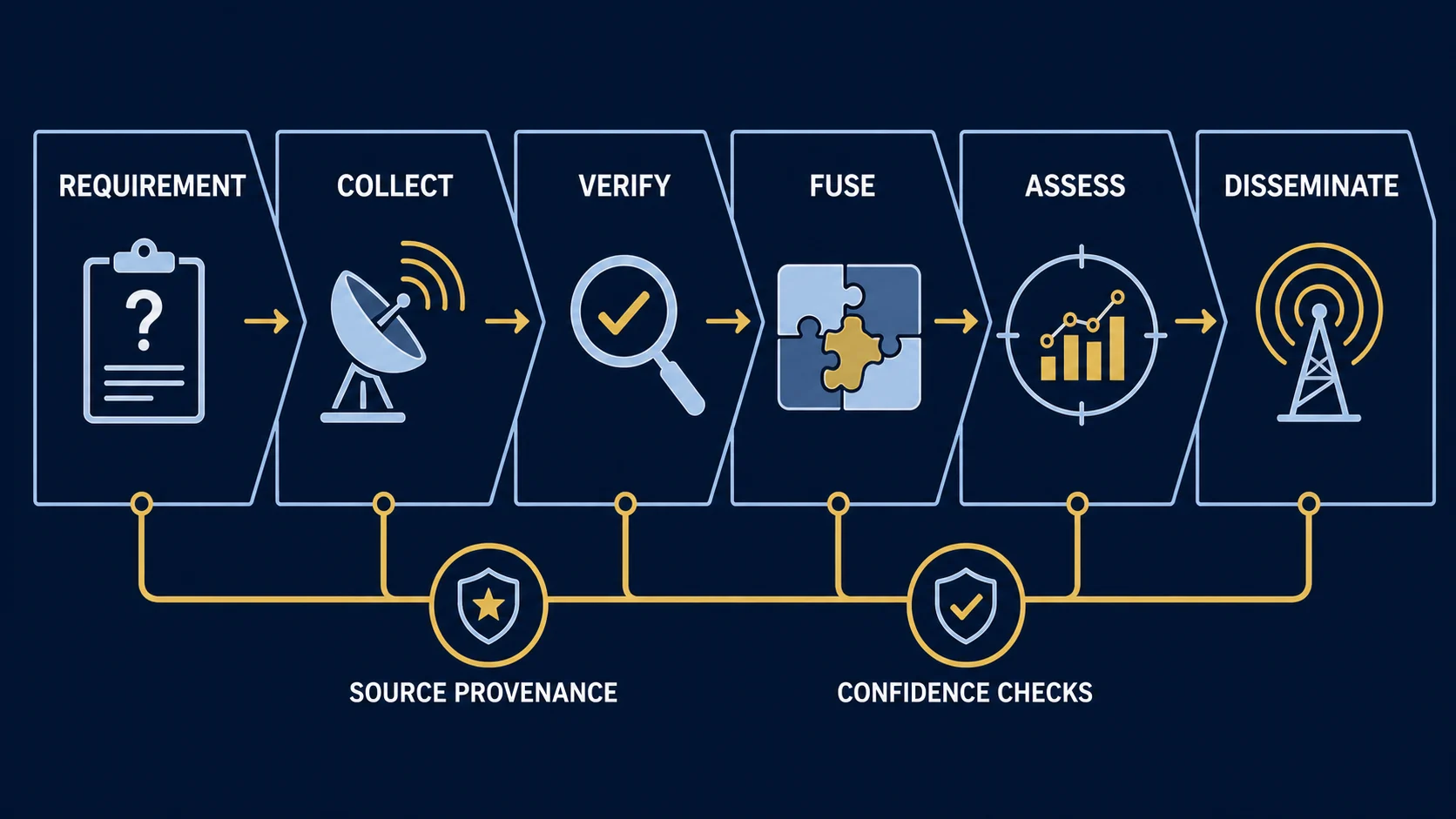
Define the requirement before collecting
ODNI defines OSINT as intelligence derived exclusively from publicly or commercially available information that addresses intelligence priorities, requirements, or gaps. The Intelligence Community overview places OSINT alongside other disciplines because its value depends on purpose and tradecraft—not merely accessibility. Collection plans should identify the decision, timeframe, essential information, geographic and language scope, and stopping conditions.
Professionalize acquisition and sharing
The IC OSINT Strategy 2024–2026 focuses on coordinated data acquisition, integrated collection management, innovation, and workforce development. For smaller teams, the same principles translate into shared source registries, licensing awareness, duplicate reduction, documented collection authorities, and deliberate partnerships.
Verify at the source level
Verification should distinguish authenticity, identity, location, time, and context. Analysts should preserve originals, record acquisition details, compare independent observations, and identify whether multiple reports trace back to one origin. The strategy document emphasizes governance and iterative implementation—both essential when commercial data, automated collection, and AI-assisted analysis change faster than static procedures.
Fuse without hiding uncertainty
OSINT becomes intelligence through structured analysis. Claims should be separated from evidence; competing explanations should be considered; confidence should reflect source quality, corroboration, and information gaps. The National Counterintelligence Strategy calls for expanded open-source capabilities while also emphasizing standards and mitigation of manipulation and deception. Those are inseparable requirements.
Disseminate for action and correction
A useful product arrives in time, answers the requirement, and allows the consumer to judge its basis. Products should include a concise assessment, key evidence, confidence, alternatives, collection gaps, and links to preserved source material. NIST's AI Resource Center is relevant when automation assists translation, entity extraction, summarization, or prioritization: testing, evaluation, verification, and validation should apply to the analytical pipeline as well as the model.
Operational takeaways
- Start with a decision-linked intelligence requirement.
- Preserve provenance and original source material.
- Separate evidence, inference, and confidence.
- Apply testing and governance to AI-assisted OSINT workflows.
Research sources
This analysis draws on the following authoritative public sources:
- ODNI — What Is Intelligence?
- ODNI — IC OSINT Strategy 2024–2026
- ODNI — IC OSINT Strategy PDF
- NCSC — National Counterintelligence Strategy
- NIST — AI Resource Center
National Defense Lab publishes independent analysis for educational and capability-development purposes. This article does not disclose classified information or represent official U.S. government policy.