
High-consequence AI systems need more than an ethics statement. They require a repeatable assurance process that starts before a model is selected and continues after deployment. The central question is not whether an algorithm is broadly “good.” It is whether a specific human–machine system performs a defined mission reliably, lawfully, securely, and understandably under the conditions where it will actually be used.
Start with mission and authority
The DoD AI Adoption Strategy ties AI to battlespace awareness, adaptive planning, resilient sustainment, and enterprise outcomes. Each use case should identify the decision being supported, the authority responsible for it, the evidence required, and the consequences of error. Without those boundaries, evaluation metrics can reward technical performance while ignoring mission risk.
Operationalize risk management
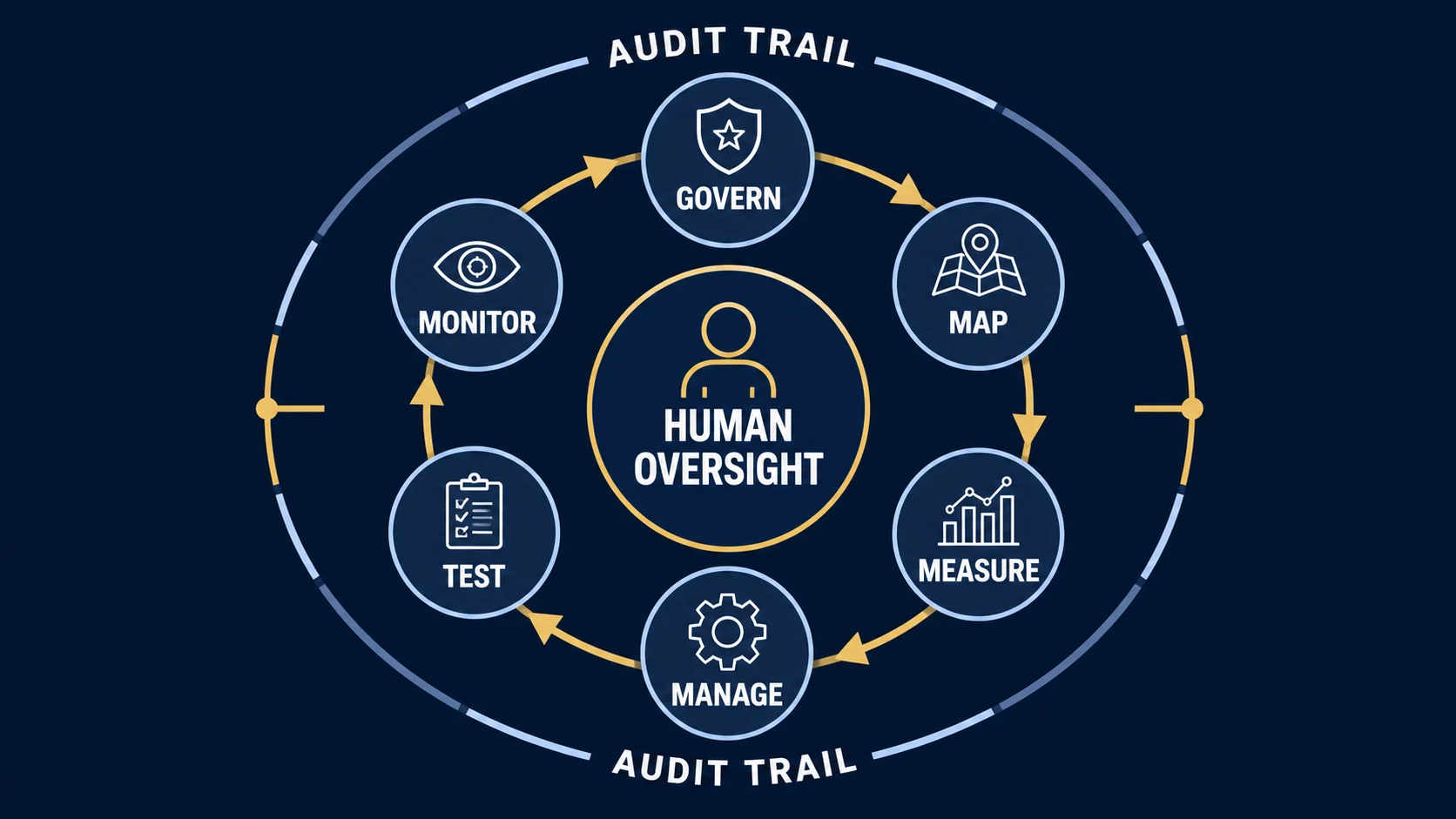
The NIST AI Risk Management Framework provides a practical structure through govern, map, measure, and manage. Governance establishes roles and accountability. Mapping defines context and affected parties. Measurement tests performance and trustworthiness. Management prioritizes and treats risk. In defense environments, these activities should be connected to test plans, configuration control, operator training, cybersecurity, and incident response.
Test the team, not only the model
A highly accurate model can still produce poor outcomes if operators misunderstand confidence, defer automatically, or cannot identify out-of-distribution conditions. NIST's human–AI interaction guidance stresses clearly differentiated human roles and the variability of human–AI outcomes. Evaluation should measure override behavior, workload, calibration of trust, decision quality, and performance when information is missing or adversarial.
Maintain traceability and monitoring
Assurance must include data provenance, model and prompt versions, evaluation records, operator actions, and the rationale for significant outputs. GAO's review of DoD AI management identifies the importance of comprehensive strategies, inventory, and clear responsibilities. A living inventory and audit trail make it possible to detect drift, investigate incidents, and determine whether a capability remains fit for purpose.
Use real experimentation to build justified trust
DARPA's Air Combat Evolution program treated trust as something to measure, calibrate, and increase through progressively realistic experimentation. That is the right model for assurance: define claims, create evidence, expose limitations, and retest as systems and environments change. Trust should be earned by observable performance—not implied by automation.
Operational takeaways
- Define the mission decision and accountable authority first.
- Translate governance into testable engineering requirements.
- Evaluate operator behavior and system behavior together.
- Maintain configuration, provenance, and monitoring records throughout the lifecycle.
Research sources
This analysis draws on the following authoritative public sources:
- DoD — Data, Analytics, and AI Adoption Strategy
- NIST — AI RMF 1.0
- NIST — Human–AI Interaction
- GAO — DoD AI Management
- DARPA — Air Combat Evolution
National Defense Lab publishes independent analysis for educational and capability-development purposes. This article does not disclose classified information or represent official U.S. government policy.