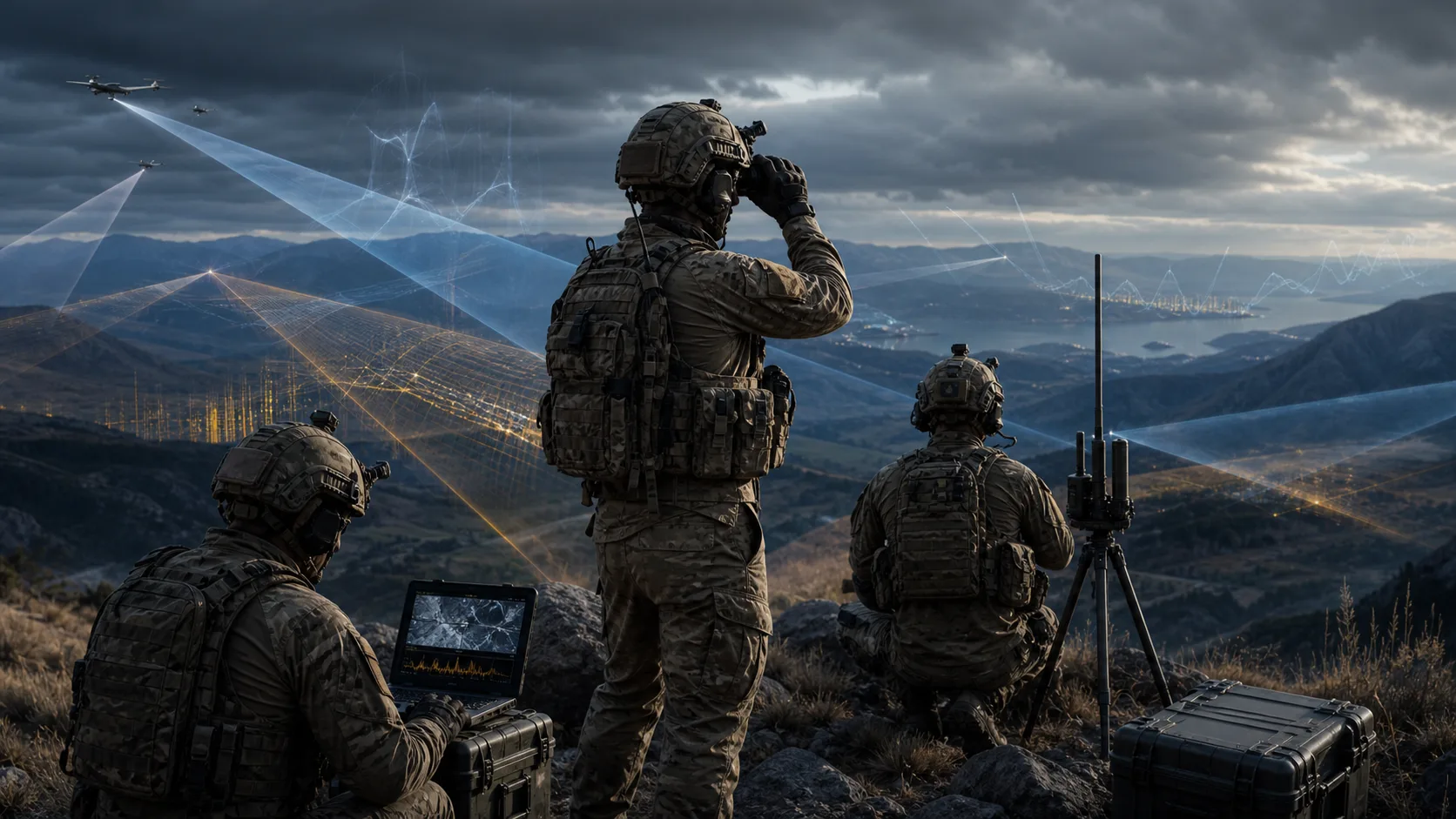
Modern sensing has made concealment a dynamic discipline. Commercial satellites, low-cost drones, passive radio-frequency collection, thermal imagers, network telemetry, and public digital traces can be combined to reveal patterns that no single sensor could confirm alone. Signature management is therefore not a camouflage task. It is the continuous practice of understanding what an observer can detect, infer, and target.
Think in signatures, not objects
An object becomes operationally meaningful through patterns: location, movement, emissions, heat, timing, association, and behavior. A visually concealed position may still be exposed by an unusual thermal profile or a predictable burst of radio traffic. The Marine Corps' Project Dynamis explicitly connects spectrum operations, spoofing, jamming, signature management, resilient data, and robotic-system command and control. That integration reflects the multi-domain character of observability.
Establish a detectable baseline
Teams cannot manage what they have not measured. Baseline work should document normal emissions, thermal cycles, network activity, movement rhythms, and visual changes over time. The Marine Corps' description of the Spectrum Situational Awareness System centers on showing commanders what friendly signatures look like. The principle applies across domains: create a representative picture, then identify which anomalies matter.
Connect reduction to mission purpose
The goal is rarely to become invisible. It is to remain below an adversary's decision threshold long enough to preserve freedom of action. Reduction measures must therefore be evaluated against mission tempo, safety, logistics, and communications needs. The Replicator 1.2 announcement notes the importance of resilient coordination in the face of jamming and countermeasures, demonstrating that survivability and connectivity must be designed together.
Account for the digital exhaust
Public posts, device identifiers, cloud access patterns, procurement records, and repeated online behavior can expose affiliation or intent. The IC OSINT Strategy recognizes the expanding value of public and commercially available information. Defensive signature management must apply the same analytical imagination to friendly digital exposure that an open-source collector would apply to a target.
Reassess continuously
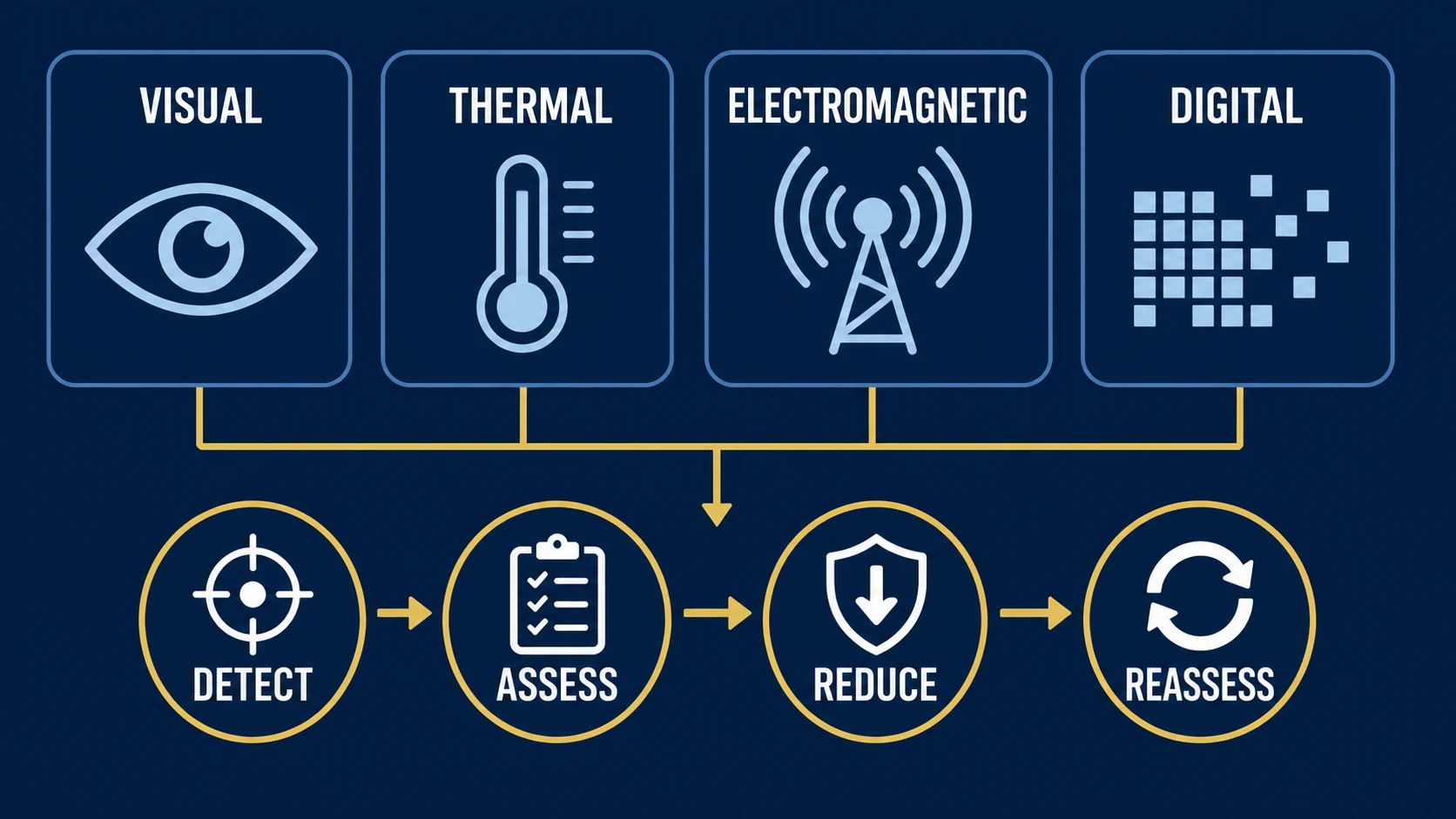
A signature plan is a hypothesis about an observer. It must be tested against realistic sensors, red-team collection, and changing conditions. Army War College analysis of the strategic environment highlights the growing importance of autonomous systems and counterintervention challenges. As the sensing ecosystem evolves, the detect–assess–reduce–reassess cycle must move with it.
Operational takeaways
- Measure visual, thermal, electromagnetic, acoustic, and digital exposure together.
- Use realistic baselines and red-team collection.
- Balance signature reduction with mission connectivity and safety.
- Treat every mitigation as a testable hypothesis.
Research sources
This analysis draws on the following authoritative public sources:
- U.S. Marine Corps — Project Dynamis
- MARFORPAC — Spectrum Situational Awareness
- DoD — Replicator 1.2
- ODNI — IC OSINT Strategy
- U.S. Army War College — Strategic Security Environment
National Defense Lab publishes independent analysis for educational and capability-development purposes. This article does not disclose classified information or represent official U.S. government policy.