
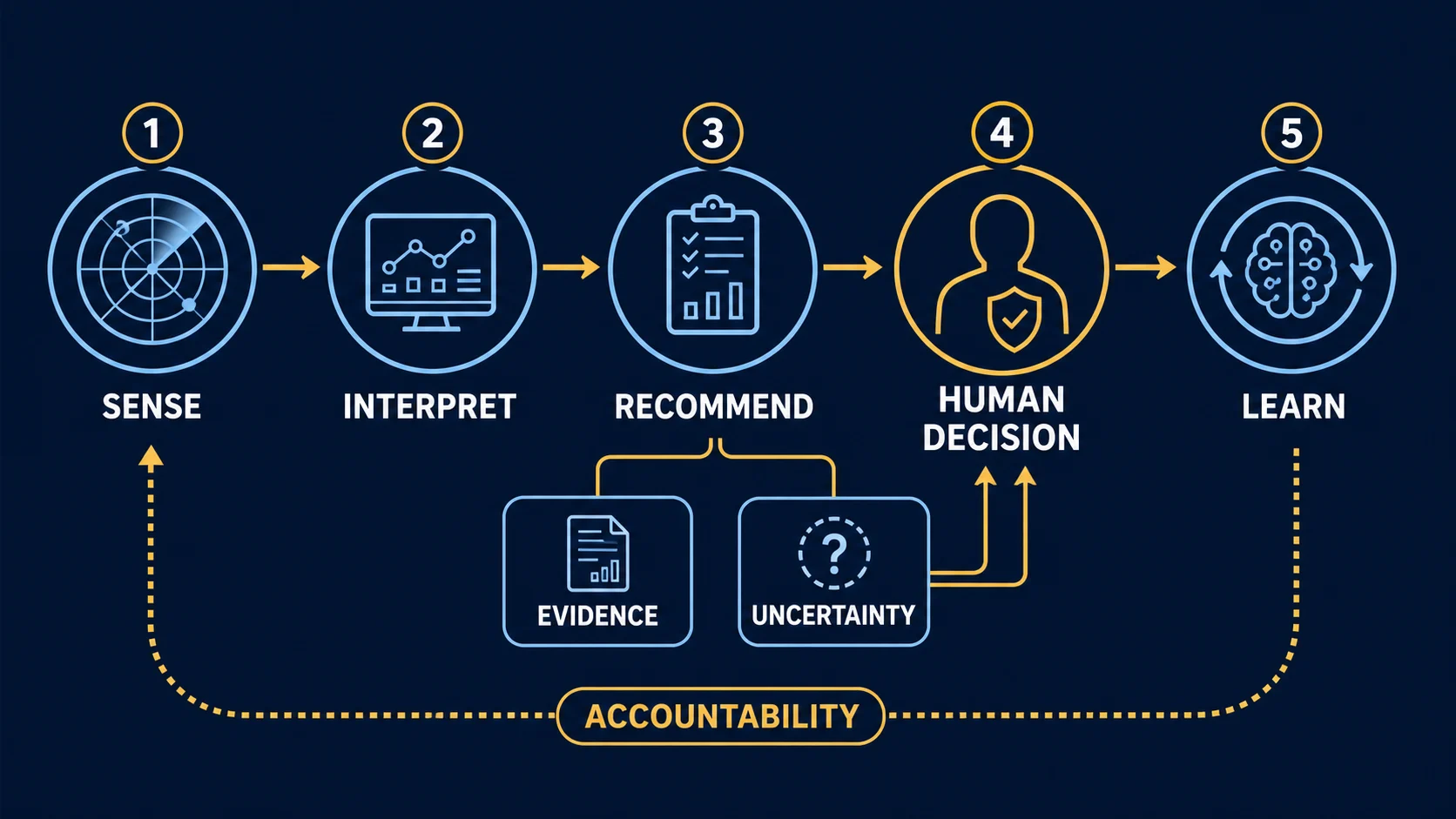
The promise of human–machine teaming is not to remove people from difficult decisions. It is to let machines handle bounded speed, scale, and repetition while people retain context, responsibility, creativity, and judgment. Achieving that complementarity requires more than adding an AI recommendation to an existing interface. The team itself must be designed.
Allocate work around comparative strengths
DARPA's Air Combat Evolution program used a hierarchical model in which autonomy performs bounded tactical behaviors while the human shifts toward mission command. That pattern is broadly useful: machines can monitor, compare, simulate, and surface anomalies; people can interpret intent, weigh consequences, reconcile values, and adapt the mission.
Make trust observable and calibrated
Trust should match demonstrated capability. Too little trust wastes useful automation; too much trust creates brittle dependence. ACE treated trust as something to measure and calibrate through increasingly realistic experiments. DARPA's later Artificial Intelligence Reinforcements program extends human feedback and distributed autonomy into more uncertain multi-agent missions, reinforcing the need for evidence-based confidence.
Show evidence, uncertainty, and alternatives
A recommendation should reveal the information that supports it, the assumptions it depends on, the uncertainty around it, and what alternatives were considered. The NIST AI RMF appendix on human–AI interaction notes that configurations range from manual to autonomous and that roles must be clearly differentiated. Interface design is therefore a governance mechanism as well as a usability concern.
Test the combined team under stress
The NIST AI RMF emphasizes trustworthy characteristics across design, deployment, use, and evaluation. Human–machine teams should be tested with incomplete data, deceptive inputs, communication loss, high workload, conflicting recommendations, and novel conditions. Measures should include decision quality, time, workload, trust calibration, appropriate overrides, and recovery from error.
Preserve accountable human authority
DoD's autonomy policy update requires appropriate levels of human judgment and realistic demonstration of performance, reliability, effectiveness, and suitability. Authority should be explicit in doctrine, procedures, software permissions, interface language, and training. A human should have meaningful options—not a ceremonial approval button.
Operational takeaways
- Allocate tasks according to human and machine strengths.
- Calibrate trust through realistic evidence.
- Expose evidence, uncertainty, and alternatives at the decision point.
- Test the human–machine team, not only the algorithm.
Research sources
This analysis draws on the following authoritative public sources:
- DARPA — Air Combat Evolution
- DARPA — Artificial Intelligence Reinforcements
- NIST — Human–AI Interaction
- NIST — AI RMF 1.0
- DoD — Updated Directive 3000.09
National Defense Lab publishes independent analysis for educational and capability-development purposes. This article does not disclose classified information or represent official U.S. government policy.