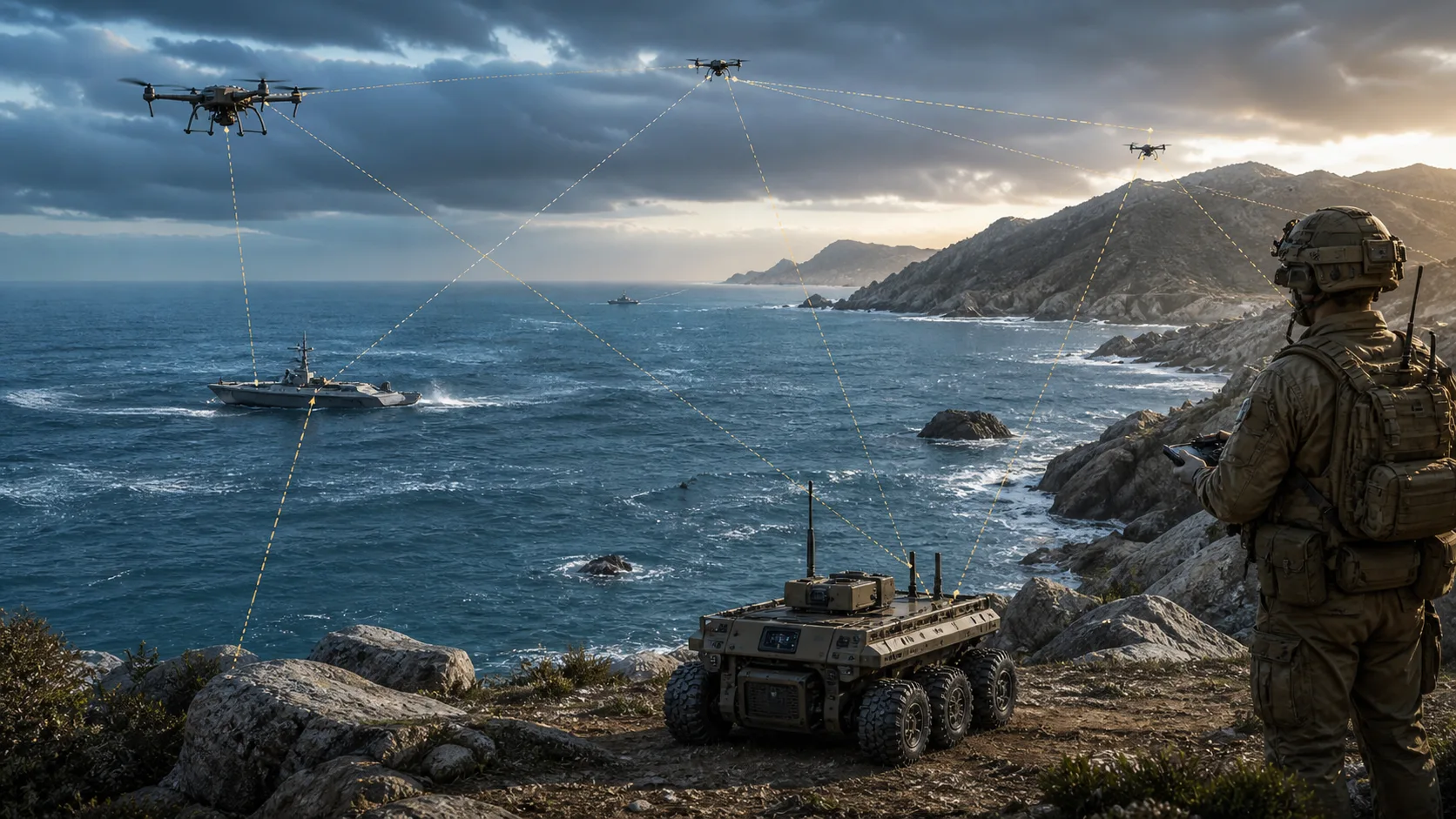
Autonomous capability is often discussed as a property of a vehicle. Operational value, however, emerges from a larger system: mission intent, sensing, communications, coordination, logistics, human authority, and safe behavior when assumptions fail. The engineering challenge is not simply making a platform move without continuous control. It is enabling a team of systems and people to continue making useful progress under uncertainty.
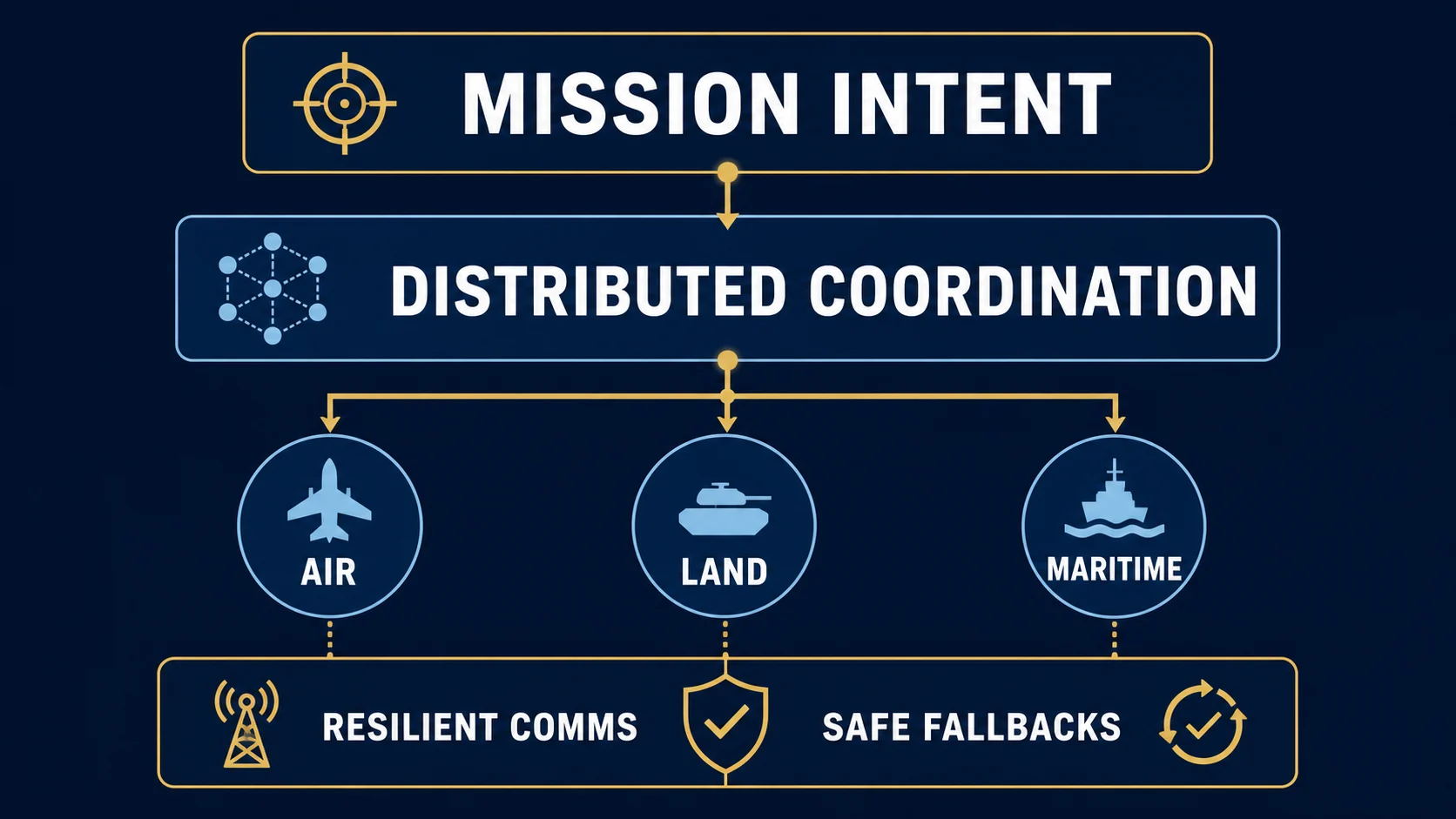
Begin with bounded mission intent
DoD Directive 3000.09 requires autonomous and semi-autonomous weapon systems to support appropriate human judgment, realistic verification, and responsible use. The Department's summary of the directive reinforces performance, reliability, effectiveness, suitability, safety, and law-of-war obligations. These are system-level requirements that should shape autonomy architecture from the outset.
Coordinate without a perfect network
Distributed systems should assume latency, loss, jamming, stale state, and conflicting observations. Replicator 1.2 includes software enablers intended to coordinate many uncrewed assets and remain resilient against countermeasures. The official announcement shows why local decision rules, compact mission updates, and graceful degradation are as important as platform endurance.
Design the portfolio, not a collection of pilots
A 2026 GAO review of Navy robotic and autonomous systems identifies leadership, organizational, and domain-silo challenges that impede urgent capability development. Common interfaces, shared evaluation infrastructure, consistent portfolio ownership, and reusable autonomy services can convert disconnected experiments into an operating capability.
Use progressive realism
DARPA's Artificial Intelligence Reinforcements program combines modeling, simulation, expert human feedback, tactical autonomy, and the hardware/software infrastructure needed for live experimentation. A responsible test campaign should progress from simulation to controlled field conditions, then expose systems to communications disruption, deceptive inputs, unexpected obstacles, and human intervention.
Make fallback behavior a first-class capability
When a system loses contact or confidence, it needs understandable and testable alternatives: hold, return, rendezvous, continue a bounded task, or transfer control. The full autonomy directive places verification and validation at the center of responsible fielding. Safe fallback behavior is one of the clearest places where policy, mission design, software, and operator trust meet.
Operational takeaways
- Treat autonomy as a distributed human–machine system.
- Assume communications will be intermittent or contested.
- Use common interfaces and portfolio-level governance.
- Test fallback behavior as rigorously as nominal performance.
Research sources
This analysis draws on the following authoritative public sources:
- DoD — Updated Directive 3000.09
- DoD — Replicator 1.2
- GAO — Navy Robotic Autonomous Systems
- DARPA — Artificial Intelligence Reinforcements
- DoD — Directive 3000.09
National Defense Lab publishes independent analysis for educational and capability-development purposes. This article does not disclose classified information or represent official U.S. government policy.